2026 World Cup Group E Preview: Germany, Curacao, Ivory Coast and Ecuador Lineups, Odds, Predictions and Tactics
The complete tactical guide to 2026 World Cup Group E brings together a four-time world champion rebuilding with purpose, the smallest country ever to reach a World Cup, an African nation returning after 12 years away and one of South America's most disciplined sides.
This is the complete tactical guide to Group E: playing style, attacking and defensive structure, key adjustments needed, predicted starting lineups, set-piece takers and the latest betting odds for Germany, Curacao, Ivory Coast and Ecuador.
Germany are heavy favorites to win the group across all major sportsbooks, but the race for second place between Ecuador and Ivory Coast is where the real value sits heading into the summer.
More 2026 World Cup Group Previews
Group C · Group E
GERMANY | 2026 World Cup Tactical Analysis and Predicted Lineup
How Germany Will Play at the 2026 World Cup
After back-to-back group-stage exits in 2018 and 2022, Germany arrive at the 2026 World Cup with something they've lacked for the better part of a decade: a clear identity. Coach Julian Nagelsmann has quietly and consistently rebuilt Die Mannschaft around a generation of elite technical talent, moving away from the rigid possession systems that defined the late manager Joachim Low era toward something more vertical, explosive and genuinely harder to defend against.
The March 2026 squad confirms that the process is in its final stages. Nagelsmann said himself that this group closely mirrors the World Cup selection he has in mind, and the tactical blueprint is now well-established: a 4-2-3-1 or 4-3-3 depending on the opponent, with Joshua Kimmich anchoring from right-back and Florian Wirtz operating as the creative hub just ahead of the double pivot, at least until Jamal Musiala reaches full fitness.
Germany's Attacking Style at the 2026 World Cup
Germany's attack is built around a generation of elite technical talent. The key attacking themes are:
- Jamal Musiala and Florian Wirtz operating in tight central and half-space zones, with the freedom to interchange constantly
- Leroy Sane or Serge Gnabry providing width and direct running on the flanks
- Kai Havertz or Nick Woltemade as the advanced reference point, combining physical presence with technical involvement
- High-tempo vertical transitions that release attacking players in space rather than circulating possession through slow build-up
When Jamal Musiala and Florian Wirtz are both free to operate between the lines simultaneously, this Germany side becomes one of the most difficult to defend against in world football. The overloads they generate through central and half-space combinations, supported by the width of the full-backs and wingers, are relentless.
The concern heading into the tournament is Musiala's fitness since he missed the March 2026 squad with an ankle reaction following his comeback from the broken leg suffered at the Club World Cup in 2025. Nagelsmann was relaxed about it publicly, describing the situation as entirely normal at that stage of recovery, but it remains the biggest open question Germany carry into the summer.
Germany's attacking depth also features multiple candidates in the 2026 World Cup Golden Boot odds.
Germany's Defensive Setup
The back line looks more stable than it has in years. Nico Schlotterbeck and Jonathan Tah form the projected central defensive partnership with Antonio Rudiger as a possible option as well, combinations that offer composure on the ball and physicality in the air. Joshua Kimmich at right-back provides tactical intelligence and control, while David Raum pushes aggressively forward on the left. The double pivot of Aleksandar Pavlovic and Leon Goretzka is designed to absorb pressure and protect the back four, giving the attacking players the license to take risks higher up the pitch.
In goal, Manuel Neuer's international retirement opened the door for Oliver Baumann, who answered the call convincingly, starting all six World Cup qualifying matches and now firmly established as first choice. The main structural vulnerability is the space left when David Raum advances and both Jamal Musiala and Florian Wirtz press high simultaneously, which sharp, pacy teams can target in transition.
Key Tactical Adjustments Germany Need to Make
- Confirm Jamal Musiala's fitness and integrate him smoothly into the tournament squad
- Maintain defensive compactness when David Raum and the attacking players advance at the same time
- Manage the double-pivot balance between Aleksandar Pavlovic's ball-carrying and Leon Goretzka's physicality
Germany 2026 World Cup Predicted Lineup
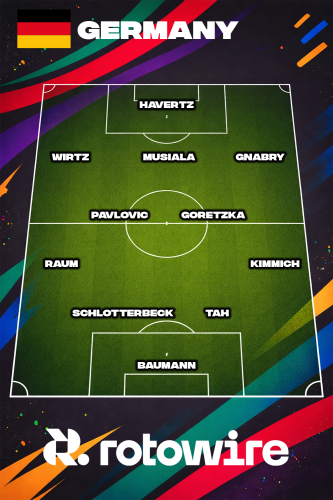
Goretzka, Pavlovic; Gnabry, Musiala, Wirtz; Havertz.
For more updates, see the latest projected World Cup lineups on RotoWire.
Germany Set Piece Takers
Corners: Joshua Kimmich, Florian Wirtz, David Raum
Direct free kicks: Joshua Kimmich, Florian Wirtz, Kai Havertz
Penalties: Kai Havertz, Florian Wirtz
Why This Germany Lineup Works
This is the starting XI that coach Julian Nagelsmann's system has been built around. Joshua Kimmich controls the tempo from right-back, the double pivot covers the defensive shape, and the front three carries the quality to break down any opponent in Group E. Jamal Musiala's inclusion in the final squad depends entirely on his fitness clearance before the announcement at the end of May. If available, Germany's attacking ceiling rises considerably.
CURACAO | 2026 World Cup Tactical Analysis and Predicted Lineup
How Curacao Will Play at the 2026 World Cup
Curacao's qualification for the 2026 World Cup is one of sport's great underdog stories. With a population of just under 186,000, they are the smallest nation by both population and area ever to reach a FIFA World Cup, a record that tells you everything about what this campaign meant to the island.
The qualification under coach and legend Dick Advocaat was no coincidence either: 10 CONCACAF matches, seven wins, three draws, and a group stage finished above Jamaica and Trinidad & Tobago. Advocaat, 78 years old when Curacao qualified, resigned in February 2026 for personal reasons, with Fred Rutten stepping in as head coach ahead of the tournament. The manager has changed, but the players, the identity, and the collective spirit have not. Their likely shape is a 4-4-2 or 4-3-3 built around disciplined organization and a squad predominantly based in the Netherlands.
Curacao's Attacking Style at the 2026 World Cup
Curacao's attacking options are limited in top-end quality, but the directness and competitive spirit are genuine. Key themes include:
- Rangelo Janga as the all-time leading goalscorer and attacking reference point, though Jurgen Locadia and Gervane Kastaneer have been preferred in recent games
- Leandro Bacuna as captain and creative anchor, carrying Premier League and Championship experience into the biggest stage of his career
- Kenji Gorre providing wide running and technical involvement from the flanks
- A direct, physical approach built to pressure opponents from the first whistle and create set-piece opportunities
Curacao are not built to control possession and that is not the plan. Their game is built on transitions, physical duels, and the kind of collective intensity that wins CONCACAF matches. Against this level of Group E opponent, they will need to be at their best from the first minute and take their chances the moment they appear.
Curacao's Defensive Setup
Curacao's qualifying defensive record was built on concentration, shape, and genuine collective buy-in. Much of the squad is Eredivisie-based, with players of Dutch descent who understand structured European defensive systems and can apply them consistently.
Juninho Bacuna was among the standout performers in qualifying, leading the team in duels won across the entire campaign. The honest challenge here is the quality gap. Germany, Ecuador and Ivory Coast all carry significantly more individual attacking quality than anything Curacao faced in CONCACAF qualifying, and sustaining their defensive standards for 90 minutes against that level of opponent will be the defining test of this tournament for them.
Key Tactical Adjustments Curacao Need to Make
- Establish a working defensive structure against opponents with genuine attacking quality
- Find a way to create and convert the limited chances they will generate across three matches
- Manage the emotional intensity of a first-ever World Cup without losing their tactical shape
Curacao 2026 World Cup Predicted Lineup
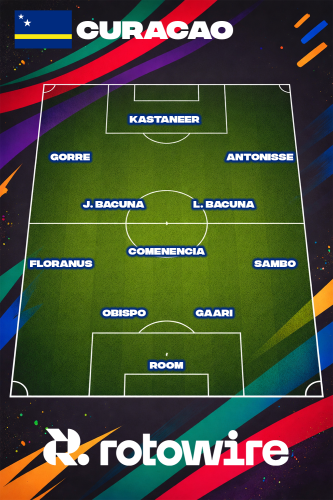
Comenencia, L. Bacuna, J. Bacuna; Antonisse, Kastaneer, Gorre.
Curacao Set Piece Takers for the 2026 World Cup
Corners: Leandro Bacuna, Jeremy Antonisse, Juninho Bacuna
Direct free kicks: Leandro Bacuna
Penalties: Leandro Bacuna, Rangelo Janga
Why This Curacao Lineup Works
This is the team that delivered during qualifying with Leandro Bacuna, Juninho Bacuna and Kenji Gorre at the core, placed inside the most organized defensive structure available. The priority for a first-ever World Cup is competitive dignity and producing their best collective output across all three matches. If the defensive shape holds and transition opportunities are taken cleanly, Curacao are capable of making life very uncomfortable for both Ivory Coast and Ecuador.
IVORY COAST | 2026 World Cup Tactical Analysis and Predicted Lineup
How Ivory Coast Will Play at the 2026 World Cup
Ivory Coast come back to the World Cup after a 12-year absence carrying real momentum. Under coach Emerse Fae, the man who became the first manager in history to be appointed mid-tournament and then win it, guiding the country to a stunning 2024 AFCON title on home soil, Les Elephants have rediscovered their identity. This is a resilient, physically powerful squad that plays better under pressure than it does in comfortable conditions, and the AFCON run proved that conclusively. Fae's base shape is a 4-3-3 built around a compact midfield block and dynamic wide attackers who can create problems in transition and in behind.
Ivory Coast's Attacking Style at the 2026 World Cup
Ivory Coast's attacking game is built on athleticism, directness and a generation of fast, technically gifted wide players. Key attacking themes include:
- Amad Diallo and the wide forwards running directly at defenders: pace, unpredictability and the ability to create from nothing
- Franck Kessie as the midfield anchor who initiates forward sequences and controls the team's rhythm in and out of possession
- Evann Guessand or an equivalent target man as the physical focal point in the box
- A clear transition game. Ivory Coast are most dangerous immediately after winning the ball, not in slow build-up phases
The attacking depth in this squad is one of the things that makes Ivory Coast genuinely tricky to prepare for. Fae has options across every attacking position and can change the shape and tempo of a match from the bench in ways that many Group E opponents will not have the personnel to match. The wide attackers, in particular, have the individual quality to create chances from very little when given space to run.
Ivory Coast's Defensive Setup
Ivory Coast's qualifying record tells the story: 10 matches, not a single goal conceded. That kind of defensive record across a full CAF-level campaign does not happen by accident. The structure is built on narrow midfield spacing and a disciplined back four that closes central channels aggressively.
The center-back pairing of Evan N'Dicka and Odilon Kossounou combines aerial strength with composure in possession, which suits Fae's preference for calm build-up from the back. Ivory Coast are very comfortable defending in a mid-block and springing quickly in transition. The challenge at this World Cup is maintaining that same level of defensive organization against the quality of Germany's attacking combinations, which are a significant step up from anything they faced in African qualifying.
Key Tactical Adjustments Ivory Coast Need to Make
- Maintain defensive solidity when Germany's half-space runners and high-tempo transitions stress the back line
- Avoid dropping too passive when possession breaks down against organized opponents
- Take their chances against Ecuador and Curacao: goal difference could matter in a close race for second place
Ivory Coast 2026 World Cup Predicted Lineup
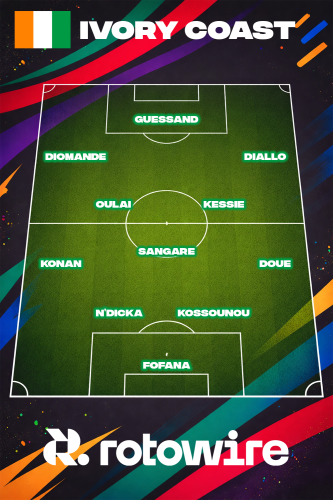
Sangare, Kessie, Oulai; Diallo, Guessand, Diomande.
Ivory Coast Set Piece Takers for the 2026 World Cup
Corners: Amad Diallo, Franck Kessie
Direct free kicks: Franck Kessie
Penalties: Evann Guessand, Franck Kessie
Why This Ivory Coast Lineup Works
Franck Kessie at the center of everything is the right call. This team's organizational identity runs through him. Around that foundation, the wide attackers get the space and freedom to do what they do best. For a squad returning to the World Cup after 12 years away, this setup balances experience, athleticism and direct attacking threat in exactly the right proportions.
ECUADOR | 2026 World Cup Tactical Analysis and Predicted Lineup
How Ecuador Will Play at the 2026 World Cup
The numbers from Ecuador's qualifying campaign to reach the 2026 World Cup are difficult to argue with. They finished second in the CONMEBOL table ahead of Brazil, Colombia and Uruguay, conceding five goals across 18 matches, with eight matches going scoreless.
Under coach Sebastian Beccacece, Ecuador have become one of the most structured, hardest-to-beat teams in South American football, a side that does not beat you with flair but earns results through patience, defensive conviction and the ability to punish a single lapse of concentration. The base shape is a 4-4-2 or 4-2-3-1 with defensive solidity as the starting point for everything.
Ecuador's Attacking Style at the 2026 World Cup
Ecuador's attack is functional rather than spectacular, but it is genuinely dangerous in the right conditions. Key themes include:
- Moises Caicedo progressing forward from deep and driving transitions from the midfield base
- Enner Valencia as the experienced focal point, the all-time leading scorer whose finishing instinct and leadership are worth more at this stage than pure athleticism
- Gonzalo Plata offering directness and unpredictability in the front line
The transition game is where Ecuador do their best attacking work. Against Germany they will absorb, stay compact and wait for moments rather than pushing for territory. They don't need to dominate possession to be dangerous, and their 1-0 win over Argentina in Guayaquil during qualifying is proof of that. The squad carries pace, a clear tactical plan and the composure of a group that has been tested against the best in South America and delivered.
Ecuador's Defensive Setup
Ecuador's back line is the foundation of everything Beccacece has built. Piero Hincapie and Willian Pacho at center-back represent one of the most accomplished young defensive partnerships anywhere in the tournament. Pervis Estupinan pushes forward from left-back while maintaining his defensive responsibilities in transition, and either Joel Ordonez or Angelo Preciado can cover the right side depending on selection.
The key to all of it is Moises Caicedo positioned ahead of the back four. His ability to intercept, press and carry gives Ecuador a defensive shield that lets the back line maintain its structure even when the team is under extended pressure. Beccacece has made this team difficult to play against, and the qualifying statistics back that up.
Key Tactical Adjustments Ecuador Need to Make
- Improve goal-scoring volume. 14 goals in 18 qualifying matches is not enough for the knockout stages
- Find creative ways to break down opponents who sit deep and invite pressure rather than pressing high
- Get the best out of young talent Kendry Paez while protecting him from the physical battles in wide areas against bigger, more aggressive teams
Ecuador 2026 World Cup Predicted Lineup
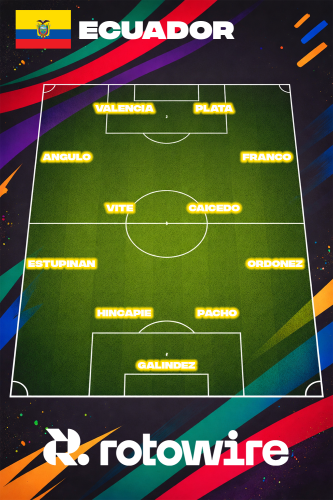
Franco, Caicedo, Vite, Angulo; Plata, Valencia.
Ecuador Set Piece Takers for the 2026 World Cup
Corners: Jordy Alcivar, Moises Caicedo, Pedro Vite, Nilson Angulo, Kendry Paez
Direct free kicks: Pervis Estupinan, Moises Caicedo
Penalties: Enner Valencia, Moises Caicedo
Why This Ecuador Lineup Works
This is a lineup built around the identity of coach Sebastian Beccacece that has developed across two years of qualifying. A dominant defensive spine, Moises Caicedo controlling the engine room, pace on the flanks to make something from nothing in transition and Enner Valencia to finish it when the moment comes. Ecuador have never gone beyond the Round of 16 at a World Cup. The structure and mentality are in place to change that.
2026 World Cup Group E Odds
Germany are priced as heavy favorites across all books, implying roughly a 70–80 percent chance to win the group. That pricing reflects squad depth, tournament pedigree and the attacking quality of Musiala, Wirtz and Havertz, the kind of front line that makes Group E a formality on paper.
Ecuador are consistently positioned as second favorite to qualify from Group E, with their CONMEBOL qualifying record and defensive structure earning respect from oddsmakers. Ivory Coast sit in a competitive but volatile tier, capable of beating anyone on their day but harder to trust across three matches at this level.
The most interesting betting angle in Group E may be the Ivory Coast–Ecuador match. The result of that game is likely to determine who advances alongside Germany, and the head-to-head odds reflect a genuine coin flip. For bettors looking beyond the group winner market, that match is the one to watch.
Visit RotoWire for exclusive sports betting picks and our daily World Cup recaps. Remember that betting apps vary in terms of odds, so we have an easy-to-use odds page that allows you to shop for the best lines at DraftKings, FanDuel, BetMGM and PointsBet. Claim over a thousand dollars in bonuses by signing up at the best sports betting sites using the best sportsbook promos.
Who Will Qualify from World Cup Group E?
Germany should win this group. Their squad depth, their history at this stage of major tournaments, and the attacking quality of Jamal Musiala, Florian Wirtz and Kai Havertz are too much for the other three teams to handle across 90 minutes. The honest question is about second place.
Ecuador are the best-organized defensive side in the group and carry genuine qualifying credibility against South American heavyweights. Ivory Coast are powerful, experienced under pressure, and have the attacking options to hurt anyone on a good day. When those two sides meet, the result is likely to determine who goes through alongside Germany.
Curacao's qualification story is one of the most remarkable in World Cup history. The quality gap is real, and nobody should pretend otherwise. But their unbeaten qualifying run and the collective spirit Advocaat built on the island are not nothing, against Ivory Coast especially. A set piece or a transitional moment could still produce something extraordinary.
Across all three matchdays, the decisive factors look clear: Germany's half-space combinations, Ecuador's transition efficiency, Ivory Coast's defensive solidity, and how long Curacao can hold their shape under the kind of sustained attacking pressure they have never faced before.
Group E Summary
| Germany | Curacao | Ivory Coast | Ecuador | |
|---|---|---|---|---|
| Predicted formation | 4-2-3-1 | 4-3-3 | 4-3-3 | 4-4-2 |
| Playing style | Vertical, high-tempo, creative half-space combinations, elite individual attack | Collective discipline, direct running, CONCACAF-built physicality | Compact block, physical transitions, pace-driven wide attack | Defensive solidity, controlled transitions, hard to break down |
| Corners/FK takers | Kimmich, Wirtz, Raum | L. Bacuna, J. Bacuna, Antonisse | Diallo, Kessie | Alcivar, Caicedo, Paez |
| Penalty takers | Havertz, Wirtz | L. Bacuna, Janga | Guessand, Kessie | Valencia, Caicedo |