

The numbers that doomed Hubert Davis were never hidden. KenPom published them every Monday morning throughout his five seasons in Chapel Hill. A #97 defensive efficiency rank. A Talent Waste Index that climbed to +38 by his final year. A 25% win rate in close games that turned late-season promise into early exits. The graphic below tells the story in four tabs. The question worth asking now: how long did UNC wait to read it?
Also: The top college basketball DFS value plays and strategy for Friday, March 20.
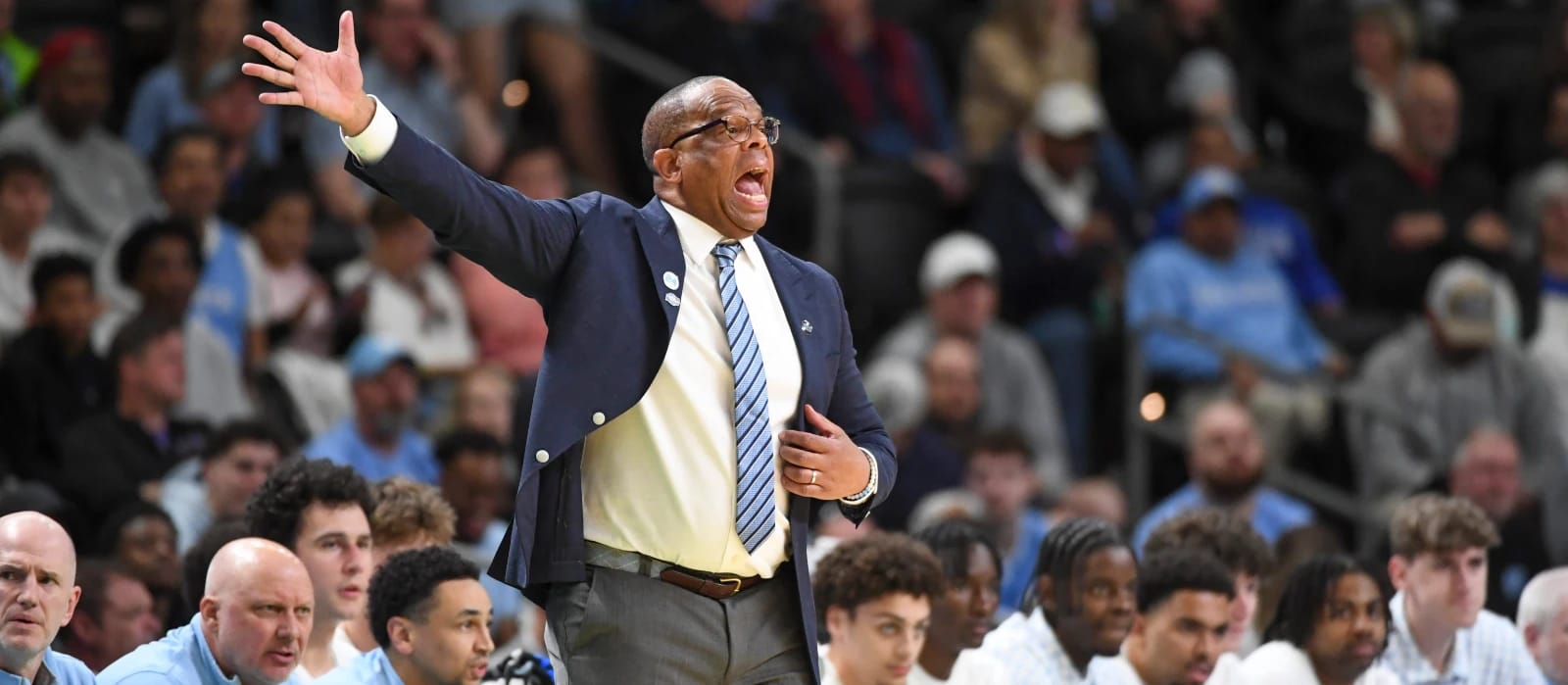
How Did Hubert Davis Lose the Locker Room on Defense?
If you watched Thursday's first round game against the Rams, you likely noticed that Hubert Davis' defense at UNC was not up to snuff, allowing VCU to hit 45% of their shots and 42% from behind the arc.
For all of UNC's issues in Greenville, the biggest one came off the bench for Phil Martelli Jr.'s Rams squad, with 6'3 guard Terrence Hill Jr. torching the Tar Heels' defense for 34 points on 13-of-23 shooting.
That in itself speaks to what might be the greatest problem that Davis and his staff have faced in five seasons, as a man who was a zero-star recruit out of Roosevelt High School in Portland, Oregon (Hill) outdueled a UNC roster chocked full of four-and-five star prospects.
At the end of the day, UNC's roster should have outclassed the A10 Tournament champs on talent alone, with Davis bringing in top 10 recruiting classes each year, but the clear disconnect of raw talent without proper player development infrastructure ultimately led to a second straight first round exit for Davis and company.
Visit the RotoWire college basketball DFS lineup optimizer to find value plays, build stacks and export up to 150 lineups directly to DraftKings or FanDuel.
As a further data point, UNC's recruiting class for 2025 (per 247 Sports) was fifth nationally, behind only Duke, Arizona, Houston and Arkansas (in that order), with On3.com ranking them 14th nationally that year. If you rewind a year, UNC's 2024 class was even better, with On3.com ranking them fifth nationally, as did 247 Sports. The team that beat the Tar Heels on Thursday (VCU) had a two-man class that ranked 72nd nationally by 247 Sports, one slot behind Purdue and just ahead of San Diego State and Kennesaw State, while On3.com had the Rams' 2025 class ranked 46th overall, between NC State and Oklahoma State.
While Davis' NCAA Tournament production didn't deliver after his team's run to the title game in his debut campaign back in 2022, it's clear that UNC basketball talent was never an issue, as the Tar Heels' recruiting never slowed down under his watch.
The amount of talent wasted, on the other hand, was a serious weak spot for Davis and his staff, with the Heels' Talent Waste Index metastasizing from +7 in his first year to +38 in Year Five, speaking to the inability he had in developing his players into successful cogs in the UNC machine.
Perhaps the other main reason why Davis underperformed in March is UNC's slow adoption of the NCAA's newfound world of the transfer portal, with the Heels' average recruiting class of transfers ranking 41st nationally over the last four years, per the team at 247 Sports.
Check out RotoWire's college basketball starting lineup data to view recent stats, usage trends and identify potential DFS value plays.
Why UNC Lost So Many Games It Should Have Won
Another theme of the last five years in Chapel Hill has been Davis' late game management, with a 25% win rate in games decided by six points or less, giving fans further proof in wondering 'why does UNC keep losing close games?'
Further, the glut of close games, in 2026 and years prior, also likely stemmed from Davis' timeout usage and implementation of an iso-heavy offense that drained seconds off the clock, forcing bad shots off little motion.
Early on, Davis' teams at UNC were able to overcome these tidbits by having players like Caleb Love and Brady Manek that could hit tough shots, helping the 2022 team reach the title game, with a 72.7% close-game win rate during that season. The next year, though, UNC's win rate in those contests dropped substantially, falling to 38.5%, speaking to the fickle nature of success in modern college hoops.
The first point about Davis' timeouts revolves around how the now-veteran UNC head coach used up most of his four TO's per game early on, leaving few (if any) to use in the final 90 seconds of a game, when his team needed a brief break or a chat about the Heels' late-game strategy.
The second one is more straight forward, as Davis' iso-heavy offense left UNC hoisting up shots with little time left on the shot clock after the four guys that didn't have the ball stood around, failing to enact the type of free-flowing motion that creates successful teams in today's world of men's college basketball.
Those two points help explain why Davis is 6-20 in his last 26 games decided by six points or less, dating back to the 2023-24 season, potentially paving the way towards a coaching change this offseason.
Right now, as we await word on whether Davis will return for a sixth season, it's not too early to cast our collective gaze forward towards who might succeed him, should Cunnigham opt for a change on the bench in 2026-27.
Some potential North Carolina head coaching candidates to keep an eye on could include names like Scott Drew of Baylor and Alabama's Nate Oats.
Any change in Chapel Hill will not come as a kneejerk reaction to Thursday's collapse in Greenville, but from five years of slow decline under Davis' watch, leading UNC's AD to potentially pull the ripcord on his reported $5.312 million buyout.
For now, we're left to wait and wonder what the next step will be under Cunningham's watch when it comes to UNC's ballyhooed men's basketball team, with any coaching changes likely to come sooner rather than later.