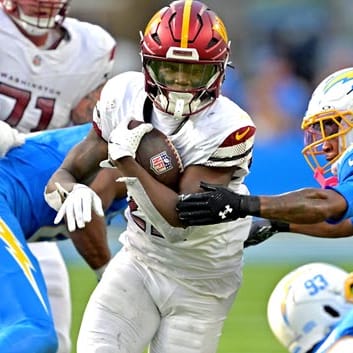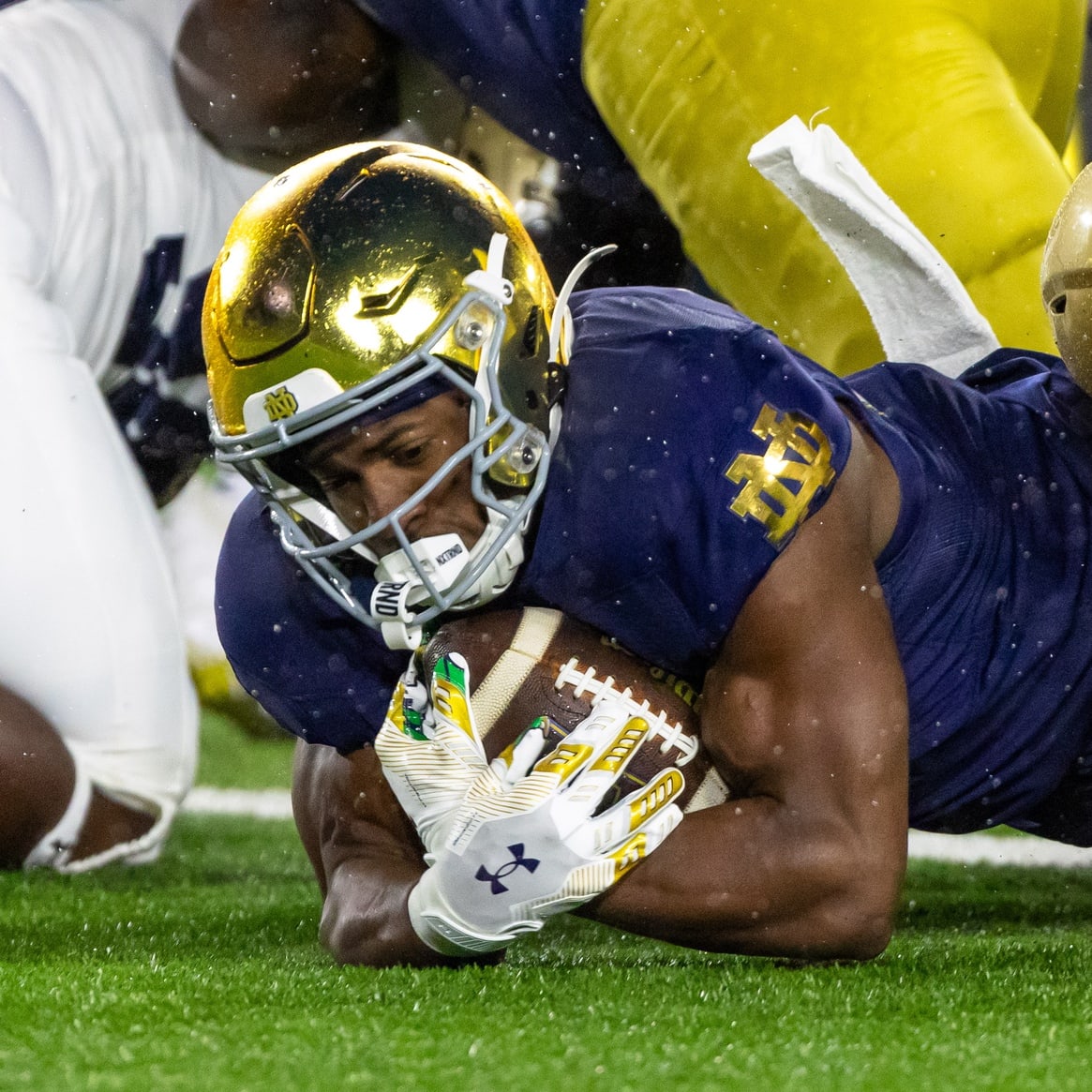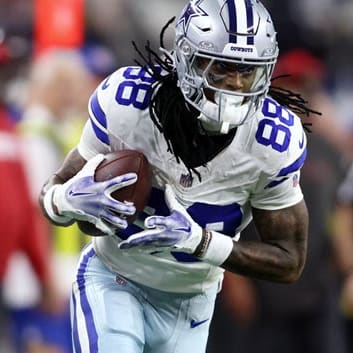
This article breaks down the Underdog best ball fantasy football ADP and identifies 10 players to target in the final rounds of Underdog football best ball drafts.
The players are all 180.0 or later in the Underdog fantasy football best ball ADP and are sorted from earliest to latest.
Jalen Nailor, WR, LV (180.9)
Nailor has a lot to prove on the one hand, yet on the other he has consistently played well with his limited NFL opportunities and he was always a good player at Michigan State – just injury prone.
Nailor often ran from the slot for the Vikings, and with a relatively high ADOT for the position. That potentially implies an offensive route assortment that used the slot for clearing routes more often than most other offenses, which makes sense with Justin Jefferson and Jordan Addison on the boundary most of the time.
In an offense where he's a featured route runner instead of running clearing routes, though, Nailor could draw targets more rapidly than he did in Minnesota or even Michigan State. No matter whether Nailor runs from the slot or/and flanker rep for Vegas, he should draw targets more rapidly than any of Tre Tucker, Jack Bech or Dont'e Thornton.
In fact, Nailor seems more likely threatened by Ashton Jeanty for the second-most Raiders targets behind Brock Bowers than any of the Raiders receivers currently on the roster. As much as there's a chance the Raiders add a wideout prospect capable of stealing looks from Nailor, for the moment we should probably assume Nailor the likely second-leading Raiders target behind Bowers in 2026.
Tre' Harris, WR, LAC (181.9)
Harris is just expensive enough that he's probably one of the lesser values of this group – a price around 200.0 would be easier to like – but there's still a chance he makes enough of a leap to prove a viable NFL starter, which at present ADP the public seems to regard as unlikely.


The Chargers at the very least appreciate Harris' blocking, and with the Chargers seemingly somewhat sore at Quentin Johnston for his ongoing drops issues they probably won't be protective of Johnston's playing time. Because he's a standout blocker and because he doesn't really drop passes, the Chargers likely are more so looking for an excuse to put Harris on the field.
If Harris can regularly earn 40-plus snaps per week then the rest of the details of his fantasy football projection would likely work themselves out. The blocking gets him about 20 snaps per week alone, so he just needs to log another 20-to-25 snaps as a route runner each week to have some de facto fantasy utility in a Justin Herbert (and now Mike McDaniel) offense.
Dylan Sampson, RB, CLE (182.9)
You don't need to assume anything especially grim about Quinshon Judkins to see Sampson as a good value this late. You don't even need to believe Sampson is particularly good. The opportunity level seems bankable either way.
Even if Judkins stays perfectly healthy, Sampson will likely be close to unchallenged as the RB2 in Cleveland, and Sampson showed enough pass-catching upside last year to project as the primary hurryup back for the Browns.
In another draft it would be easier to worry about the Browns drafting a standout running back, but in this particular draft it would be surprising if Cleveland could get their hands on any player capable of sending Sampson to the bench. A trade would be a far more likely way of Sampson losing playing time, yet there's no expectation of that occurring either.
Chimere Dike, WR, TEN (185.6)
It's best to assume Wan'Dale Robinson is the likely WR1 for Tennessee in terms of the target rotation, and it's also best to figure Tennessee for one of the lesser passing offenses league-wide until they prove otherwise.
Even so, Dike doesn't seem to have any true risk at this point in the ADP. It would be something different if he were going in the 12th round, but in the 16th round there's only so much that can go wrong.
Even if Tennessee keeps Calvin Ridley around as the primary flanker, thus presumably leaving Robinson with the slot and Dike with a sacrificial 'X' role running clearing routes, Dike is also good at running deep routes, it's just something Tennessee didn't ask of him last year. Similarly, Dike was never given the chance in college to operate as an underneath wideout or returner, yet as a rookie Dike was clearly promising as a slot wideout and as a returner he was one of the very best.
There's reason to believe Dike is something like the next Rashid Shaheed. He doesn't really have the presence of a WR1, but he's so explosive at multiple levels that he can always pose some kind of big-play threat.
Eli Stowers, TE, Vanderbilt (186.5)
Stowers is about two rounds more expensive now than he was before the Combine – hopefully you grabbed a few shares of Stowers as TE3 at that price, as we previously advised – but even at this more expensive price Stowers is still worth drafting as a TE3.
It's easy to make the case that Stowers remains a clearly preferable target to options like David Njoku (185.7), Chig Okonkwo (172.6), AJ Barner (171.8), and even Brenton Strange (143.2). You'd ideally have a better player than all of these candidates in your TE2 role, and if so it would give you the flexibility to aim for a little more upside in your TE3 slot.
Stowers offers enough upside as a TE3 to basically disregard what otherwise might be a low floor. The potentially low weekly floor would be more of an issue as a TE2, but if you have a TE2 capable of addressing the floor concern then within that TE3-eligible category there simply aren't any candidates who offer the combination of athleticism and production to project as a standout NFL target to the extent Stowers does. And of course, Stowers' price can get more expensive yet if he lands with the right team.
Nicholas Singleton, RB, Penn State (199.2)
Singleton's price should stay mostly stable until the draft, at which point it could rise or drop depending on his draft outcome, so he should be available around the ~200th pick for a month or so.
Though his price is high enough that there is probably more objective risk than most other entries on this list, the general fantasy football public seems to regard him as only a borderline sixth- or seventh-round draft pick. That's probably selling Singleton short.
A lot of things can go wrong for rookie running backs, especially ones who don't get drafted early, but there are numerous rookie running backs for whom this concern is equal or greater than in Singleton's case who go earlier than Singleton in the ADP. None aside from Jeremiyah Love boasts the combination of big-play ability and passing-down utility that Singleton does.
Kaytron Allen (198.3) and Mike Washington (134.4) in particular should not be going ahead of Singleton, in my opinion. Every criticism people level on Singleton applies to Washington but to significantly greater magnitude. Even by the reasoning of Washington advocates themselves, Singleton is at worst the same type of player as Washington but much better at passing downs and ball security.
It's purely a trick people are playing on themselves to see Washington as a preferable to Singleton. A lot of people in the scene are feeling browbeaten into going along with the dominant narrative and can't actually explain lucidly why they're high on Washington.
If you don't like Singleton then there are only self-contradictory cases for favoring Washington, but you can like only Singleton of the two without backtracking over your own reasoning.
Ryan Flournoy, WR, DAL (208.3)
Flournoy exposure is almost purely handcuff logic, which isn't as commonly referenced at wide receiver as at running back. It still makes clear enough sense in Flournoy's case, though, if only because he already demonstrated the premise last year. Be it part of a Dallas stack or just a one-off pick, Flournoy is a receiver worth mixing in at this price.
Flournoy can only provide flickers of production when his role is that of WR3 – sometimes the fourth-leading pass catcher behind Jake Ferguson additionally – but Flournoy's production gives reason to suspect he might be overqualified in that role. In the event that CeeDee Lamb, George Pickens or even Ferguson are on the sideline Flournoy could push for something like top-30 wideout utility.
There's a funny potential parallel between Flournoy and former Dallas receiver Laurent Robinson (2011). Though Robinson was a more distinguished prospect as a third-round pick out of Illinois State, both he and Flournoy were fast and springy athletes from smaller schools.
Robinson was initially behind Dez Bryant, Jason Witten and Miles Austin in Dallas' rotation that season but several starts opened up due to Bryant and Austin combining to miss eight games. Robinson seized the resulting opportunity by catching 54 receptions for 858 yards and 11 touchdowns on 80 targets, logging double-digit fantasy points in nine of his 14 games that year.
Ray Davis, RB, BUF (208.8)
It's understandable that best-ball drafters have Ray Davis Fatigue at this point with two mostly invisible seasons to begin his NFL career, but the same handcuff logic that applied in previous seasons remains intact.
If you drafted Davis in either of the last two years it was because of the upside he would pose in the event that James Cook missed time. You didn't make that pick with the hope that Davis would send Cook to the bench – Davis would have been much more expensive if that were the expectation. Davis needs Cook out of the picture to express mainstream fantasy utility.
The reason you might have drafted Davis previously is because of that one particular if scenario because if Cook missed time then Davis would go from useless to extremely valuable. Ty Johnson is almost exclusively a sub-package player – if Cook were to miss time then Davis would go from RB3 in their rotation to RB1.
As much as it's possible that the Bills could bring more competition via the draft, this draft is too weak to offer many clear upgrades over Davis, who was a totally decent fourth-round pick in a much tougher draft.
Jordan James, RB, SF (236.1)
Though James doesn't project as a true workhorse in even his best-case scenarios, there remains reason to think/hope he establishes himself as a useful rotational player for San Francisco to the extent that he's the primary RB2 behind Christian McCaffrey.
James fell to the fifth round of last year's draft probably due to anticipated volume concerns, as opposed to the belief that he couldn't advance the ball from scrimmage. At 5-foot-10, 205 pounds James perhaps wouldn't hold up to starter's workload for an entire season, but he can probably create yardage as a runner and pass catcher both. His rushing production at Oregon more or less matched that of Bucky Irving, who split the Oregon backfield with James in 2023.
If the 49ers re-sign Brian Robinson or select a notable running back prospect in the draft then it would of course be a strike to James' projection, but his price probably wouldn't get much cheaper since the current price seems to assume James as the RB3 at most in San Francisco.
If the 49ers don't re-sign Robinson then James' price could jump quite a bit, because this particular draft is not likely to present competition to James. If James were in this draft class he would probably be a Day 2 pick.
Tyquan Thornton, WR, KC (236.9)
As much as Xavier Worthy could experience a Jameson Williams-like glow-up in the near future and as much as the Chiefs might use a significant draft pick at the wide receiver position, Thornton is worth keeping in mind in the last round given the non-zero chance he ends up the WR3 in Kansas City for 2026.
The Chiefs re-signed Thornton to a two-year, $11 million deal after a quietly productive debut in Kansas City last year, turning 36 targets into 19 receptions for 438 yards and three touchdowns on 367 snaps. Modest as that target rate might be, Thornton's big-play ability (12.2 YPT) should be an ongoing feature, and 36 targets on 367 snaps is actually pretty good given the extremely high ADOT (25.9).
In a 2025 season where a lot went wrong for the Chiefs, Thornton was one of the few bright spots. His 1.79 yards per route run ranked 76th percentile among wide receivers last year, and his play in Kansas City is consistent with what was expected of Thornton when he was a second-round pick out of Baylor.