Spring training is here and there will be plenty of starting jobs on the line, some of which will have significant fantasy implications. I'll be covering the National League as we break down some of those battles, while Ryan Boyer handles the American League. With the AL East, NL East and AL Central already done, next up is the NL Central.
Editor's note: the number in parenthesis is the player's NFBC ADP since 2/1
NL CENTRAL BATTLES
 Chicago Cubs
Catcher: Carson Kelly (412), Moises Ballesteros (474), Miguel Amaya (540)
Kelly heads into the season as the incumbent after posting career highs in plate appearances (421), RBI (50) and runs (48) in 2025, along with 17 homers and a .249/.333/.428 slash line. The overall numbers were similar to his 2019 campaign with Arizona, but it was very much a tale of two halves for the 31-year-old, who headed into the All-Star break last year with an .899 OPS but stumbled to a .596 OPS in the second half. The increased workload was in part due to injuries to Amaya, who had a .281/.314/.500 line in 28 big-league games through late May before essentially missing the rest of the season. If the 26-year-old can stay in the lineup, he has the upside to push Kelly into a timeshare, making Amaya an intriguing target if you're bargain-hunting in two-catcher formats.
Of course, the Cubs would love it if Ballesteros were a significant part of the puzzle behind the plate, but the 22-year-old
Spring training is here and there will be plenty of starting jobs on the line, some of which will have significant fantasy implications. I'll be covering the National League as we break down some of those battles, while Ryan Boyer handles the American League. With the AL East, NL East and AL Central already done, next up is the NL Central.
Editor's note: the number in parenthesis is the player's NFBC ADP since 2/1
NL CENTRAL BATTLES
Chicago Cubs
Catcher: Carson Kelly (412), Moises Ballesteros (474), Miguel Amaya (540)
Kelly heads into the season as the incumbent after posting career highs in plate appearances (421), RBI (50) and runs (48) in 2025, along with 17 homers and a .249/.333/.428 slash line. The overall numbers were similar to his 2019 campaign with Arizona, but it was very much a tale of two halves for the 31-year-old, who headed into the All-Star break last year with an .899 OPS but stumbled to a .596 OPS in the second half. The increased workload was in part due to injuries to Amaya, who had a .281/.314/.500 line in 28 big-league games through late May before essentially missing the rest of the season. If the 26-year-old can stay in the lineup, he has the upside to push Kelly into a timeshare, making Amaya an intriguing target if you're bargain-hunting in two-catcher formats.
Of course, the Cubs would love it if Ballesteros were a significant part of the puzzle behind the plate, but the 22-year-old prospect's defense is a major liability. He heads into 2026 with just UT/DH eligibility in most leagues, and even if he does see occasional action at catcher in the majors, it'll be a while before he ekes out in-season eligibility without massive improvement with his glove and arm. His upside as a hitter is undeniable, though, and over 114 games for Triple-A Iowa last year he slashed .318/.385/.474 with 13 homers and a 49:67 BB:K, posting similar ratios during his 20-game audition with the Cubs.
Designated hitter: Ballesteros, Michael Conforto (733), Kevin Alcantara (735), Dylan Carlson (NR), Chas McCormick (NR)
In the unlikely event Ballesteros isn't deemed ready for an Opening Day spot on the 26-man roster, it would open the door for Conforto to get more work. The 32-year-old saw his numbers crater last season with the Dodgers, but it's not entirely clear why — his bat speed, hard-hit rate, average exit velocity, max EV and barrel rate were all around his career norms. Conforto did struggle to hit for power at Chavez Ravine (eight of his 12 homers in 2025 came on the road) and his BABIP was a career-low .247, so a change of scenery might do him good. Chicago brought him in on the cheap to potentially handle right field against tough righties and when Seiya Suzuki needs a breather, but there are ways for him to carve out a larger role.
If instead Conforto looks completely washed this spring and doesn't win a spot at all, it could open the door for Carlson or McCormick to claim that depth RF/DH role instead. Carlson, as a switch hitter, would be the better fit as a puzzle piece. Alcantara is a 23-year-old prospect with a minor-league option remaining, so he'd have to significantly out-perform the veterans to break camp with a job.
 Cincinnati Reds
First base: Sal Stewart (195), Spencer Steer (282), Christian Encarnacion-Strand (713)
After an impressive 2025 campaign that saw Stewart slash .309/.383/.524 over 118 games in the high minors with 20 homers and 17 stolen bases before holding his own in the majors in September, the starting job at first base is the 22-year-old's to lose. The steals may not accompany him to the big leagues, but Stewart is just beginning to tap into his power and has a plus hit tool, giving him legitimate Vladimir Guerrero Jr.-like upside once he reaches his ceiling.
If Stewart doesn't seem ready, Steer would likely handle the bulk of the work at 1B instead of being in left field. The 28-year-old has popped 20-plus homers in three straight seasons, but he didn't run as much in 2025 after swiping 40 bags over the prior two years, and his overall performance has declined since 2023.
Encarnacion-Strand has teased upside in the minors, but over the last two seasons he's slashed .199/.227/.337 in 65 big-league games. The 26-year-old did improve his contact rate last year in a smallish sample, and he's not so far removed from a 2023 campaign in which he slugged 33 homers between Triple-A and the majors that he can be written off completely. If a path opens up for him to get consistent playing time in Great American Ball Park, he might capitalize.
Left field: Steer, JJ Bleday (662), Will Benson (718), Dane Myers (744)
If Steer is needed at first base, or if his back issues crop up again, left field will likely become a platoon between either Bleday or Benson on the strong side and Myers as the lefty-killer. Bleday has never lived up to his billing as the fourth overall pick in the 2019 draft, and after slugging a career-high 20 homers during the A's final season in Oakland in 2024, his playing time dwindled last year and he was one of the rare left-handed A's who couldn't really take advantage of Sutter Health Park.
Benson continues to look more like an athlete than a ballplayer, but there were some signs of skills growth in 2024 as his contact rate jumped from a putrid 55.1 percent in 2024 to a career-high 70.9 percent in 2025. There wasn't a trade-off in terms of weaker contact, either, as his 53.8 percent hard-hit rate would have been in the 96th percentile, tied with Byron Buxton, if he'd seen enough playing time to qualify for the Statcast leaderboard. On the downside, despite his 94th percentile sprint speed, Benson went just 2-for-4 on the basepaths with the Reds.
Myers, acquired from the Marlins in the offseason, offers some power, speed and solid defense across the outfield and a career .297/.360/.456 slash line against left-handed pitching, albeit in just 203 plate appearances.
Fifth starter: Chase Burns (115), Rhett Lowder (613)
Editor's note: Since this article was written, Hunter Greene has been diagnosed with right elbow stiffness and will undergo an MRI, which could mean both these pitchers open the year in the rotation.
Cincinnati's rotation appears basically set, so this probably isn't much of a battle, but the team will at least force Burns to earn his spot in camp. The 23-year-old right-hander boasts a 98.7 mph fastball and a slider that had a 43.9 percent whiff rate in his big-league debut last year, and so far in his career he hasn't needed much more than that to dominate. Burns may need his changeup to develop into a more consistent pitch (he threw it just 5.6 percent of the time) to reach his full ace-level upside, but even his healthy floor looks like something in the Dylan Cease range.
If Burns takes a step back or an injury opens up another spot, Lowder could get a look. He threw only 9.1 minor-league innings due to forearm and oblique injuries in what was a lost 2025, but the right-hander was the seventh overall pick in the 2023 draft out of Wake Forest, flashing a potentially plus changeup to go along with a fastball, sinker and slider. The Reds will keep an eye on his workload, but he looks healthy to begin spring training and should be able to contribute if needed.
Julian Aguiar and Brandon Williamson, both of whom missed 2025 after undergoing Tommy John surgery, look healthy to begin spring training and might also be rotation options, but only if Burns and Lowder both falter.
 Milwaukee Brewers
Third base: Luis Rengifo (472), David Hamilton (668)
The wheelin' and dealin' Brewers sent Caleb Durbin to Boston this offseason but quickly signed Rengifo to replace him at the hot corner. The 29-year-old switch hitter is coming off his worst season since emerging as a regular for the Angels, but over the prior three campaigns he slashed .273/.323/.431 with close to 20 homers and 20 steals per 162 games (to be a little more precise, 19.1 homers and 17.6 steals). While Rengifo does have the defensive versatility for a super-utility role, Milwaukee only has a hole at third base.
If Rengifo isn't able to regain his form, the next man up might have to be Hamilton, who was picked up in the Durbin trade. Hamilton doesn't offer much power and has a career .222/.283/.359 slash line in 550 big-league plate appearances, but the 28-year-old infielder has swiped 57 bags in 68 attempts, giving him some late-round steals potential.
Center field: Jett Williams (585), Garrett Mitchell (608), Blake Perkins (746)
While Williams is the first of this group coming off the board on average, he'll probably begin the season at Triple-A Nashville. Acquired in the Freddy Peralta trade with the Mets, the 22-year-old prospect is a shortstop by trade and has also been getting some reps at third base this spring, so it's not entirely clear what the Brewers' plans are for Williams in the long run.
Mitchell looked ready to take a big step forward in his career after he posted an .811 OPS with eight homers and 11 steals over 69 big-league games in 2024, but injuries once again laid the 27-year-old low last year. When healthy, he's demonstrated power, speed and good center-field defense, but since being drafted in the first round in 2020 he's dealt with shoulder issues as well as hand and oblique injuries.
Perkins is a 29-year-old switch hitter with some steals upside but not much else. The trade that sent Isaac Collins to the Royals this offseason does seem to lock Perkins into a bench role, however, and a clear path to at least semi-regular playing time in center whenever Mitchell is on the shelf.
Fourth/fifth starter: Logan Henderson (275), Chad Patrick (335), Brandon Sproat (582), Kyle Harrison (620), Robert Gasser (661)
The Brewers are optimistic Brandon Woodruff (lat) won't need to begin the season with an IL stint, and Quinn Priester and Jacob Misiorowski seem secure in their rotation spots. That leaves two openings for the next wave of younger arms.
Henderson stands out thanks to a potentially elite changeup that he rode to 120 strikeouts in 103 innings between Triple-A and the majors last year. It's the the right-hander's only standout pitch, however, as his fastball averaged 92.9 mph — still over 10 mph faster than that cambio — and his cutter and slider are really just show-me offerings right now. That workload was also a career high, and his 2025 season ended early due to a flexor strain. If he can show a little more durability, he's probably a favorite to claim one of those open rotation jobs, and it's not like the former employers of the Airbender, Devin Williams, have any qualms about pitchers with a changeup-heavy arsenal.
Patrick doesn't have a true plus pitch like Henderson does, but he was effective in his big-league debut by keeping hitters guessing on which wrinkle he was going to add to his fastball on any given pitch, as he threw a four-seamer, two-seamer or cutter 86.4 percent of the time. It's an arsenal that might be better suited for a swingman role, which is how he ended 2025, but the 27-year-old right-hander gives the Brewers a high-floor rotation option until someone else pushes him aside.
Sproat, also picked up the from the Mets in the Peralta package, has tremendous upside if he can figure things out. The 25-year-old right-hander threw five pitches more than 10 percent of the time over his first five MLB starts, leaning on a 95.7 mph sinker for groundball outs and showing a four-seamer, sweeper, curve and changeup that each have some intriguing characteristics. It's the kind of profile that the Milwaukee pitching factory could develop into a No. 2 or No. 3 starter, but how quickly they're able to mold him into an asset is the question.
Harrison has now been traded twice in less than a year, going from the Giants to the Red Sox in the Rafael Devers deal last summer before getting flipped to the Brewers for Durbin. The fact that organizations with strong track records for pitching development have been interested in him is a definite selling point for the left-hander, but his walk rate regressed in 2025 while Boston had him focus on his pitch mix and sequencing. Another shift in approach and philosophy from Milwaukee likely won't lead to a hot start to the campaign, but Harrison can get strikeouts with any of his mid-90s four-seamer, slurve or changeup.
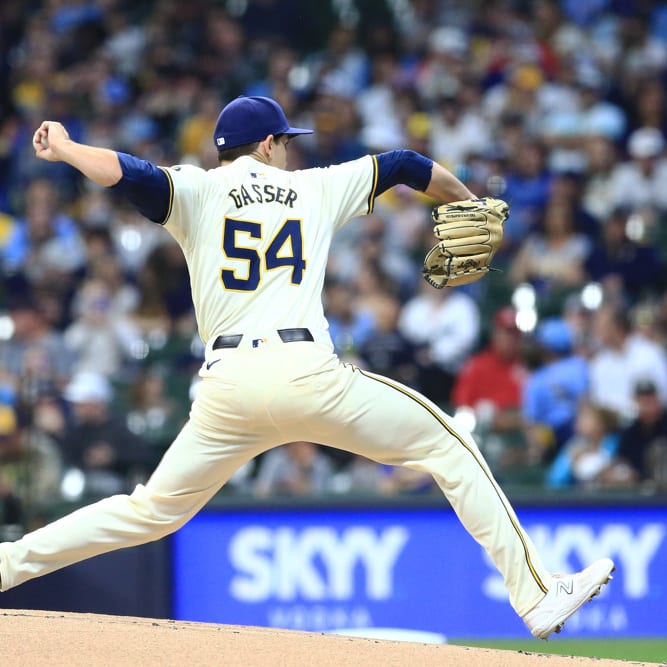
Gasser made his return from June 2024 Tommy John surgery last year, managing 43.2 innings between the minors and a late September call-up while putting together a 46:15 K:BB. The 26-year-old southpaw gets whiffs with his sweeper while working off a four-seamer and two-seamer, both around 93 mph, and he sprinkles in a changeup as well. He was also working on a cutter prior to the surgery, but he barely used it after his return. Gasser has become a bit of a forgotten prospect in the system, especially after shiny new toys Sproat and Harrison were brought in, and he's the dark horse in this rotation battle.
Closer: Trevor Megill (144), Abner Uribe (176), Craig Yoho (NR)
The Brewers never seem to have trouble churning out high-leverage reliever, and after Devin Williams followed Josh Hader out the door, Megill was the next man up as closer. The right-hander has 51 saves over the last two seasons with a 2.60 ERA, 1.07 WHIP and 110:31 K:BB in 93.1 innings, but slight durability and consistency concerns keep him out of the top tiers in the closer rankings. He could face a real threat this season for ninth-inning work from Uribe, who dazzled with a 1.67 ERA, 1.04 WHIP and 90:27 K:BB in 75.1 innings last year with 38 holds and seven saves. Milwaukee's track record suggests Uribe will stay as a high-leverage fireman until Megill inevitably gets traded, but an untimely injury for the incumbent could be all Uribe needs to seize the closing gig.
Yoho was a preseason darling heading into 2025, and while he still dominated at Triple-A, his MLB debut was shaky, to say the least. Big-league hitters weren't particularly fooled by his wicked 77.1 mph changeup, a pitch he threw 46.0 percent of the time while working off a 92.7 mph four-seamer. It might be more of a set-up profile in the long run, but Yoho can't be ruled out of the late-inning mix if he makes the necessary adjustments.
 Pittsburgh Pirates
Catcher: Joey Bart (585), Henry Davis (634), Endy Rodriguez (746)
Bart's track record has him slightly ahead in ADP, despite last year's collapse in his production. He did turn things around in the second half to some extent, slashing .294/.417/.471 over his last 32 games, but that came with only three homers and a 28.2 percent strikeout rate. Davis is headed firmly for Bustville after being the first overall pick in the 2021 draft, slashing a poor .181/.262/.294 with a 28.9 percent strikeout rate through his first 657 big-league plate appearances, but he overhauled his swing mechanics this winter in an effort to turn things around. He's still only 26, and catchers can be late bloomers at the plate, but he's got a long way to go just to become a viable second catcher for fantasy purposes. The Pirates' investment in him probably gives Davis the edge for playing time, however, regardless of how he hits.
Rodriguez was once a promising backstop prospect, but multiple elbow surgeries have likely ended his chances of a full-time career behind the plate. The 25-year-old switch hitter will have to hit enough to carve out a path to a utility role in the 1B/DH mix.
Third base: Jared Triolo (505), Nick Gonzales (647), Nick Yorke (747), Enmanuel Valdez (NR)
Pittsburgh doesn't yet have a clear successor to Ke'Bryan Hayes. Triolo will get first crack at the starting job at the hot corner thanks to his strong glove — the Bucs are used to a defense-first third baseman, after all — but he also held his own at the plate after taking over for Hayes in 2025. From August 1 on, Triolo slashed .276/.353/.422 over 52 games with four homers and eight steals in nine attempts. The speed is probably more likely to repeat than the rest of that package, as his career slash line in the majors is just .236/.320/.347, but it was enough to earn him a longer look.
If Triolo regresses as a hitter, the Pirates have a collection of other utility players to try out in his place. Gonzales hasn't been able to decide what kind of hitter he wants to be as a professional, and the 26-year-old has a .257/.300/.375 slash line in the majors with 14 homers in 225 games. He's shown more power in the minors, but it came with ugly strikeout rates. Yorke was picked up last season in a trade for Quinn Priester, and while the 23-year-old has yet to do much in the big leagues, he did slash .287/.348/.406 at Triple-A in 2025 with seven homers and 17 steals over 103 games. His focus this offseason has been on muscling up and adding more loft to his swing, and aside from an injury-plagued 2022 he's produced in the minors, so if you're looking for a late-round dart throw on the Pittsburgh infield, Yorke's your guy.
Valdez has flashed occasional pop and good defensive versatility around the infield, and as the only left-handed hitter among the trio behind Triolo, he might have a safer path to a bench job on the 26-man roster than Yorke or Gonzales.
Shortstop: Konnor Griffin (191), Gonzales
The door is wide open for Griffin to claim the starting job at shortstop, and three homers in his first six spring games isn't going to do anything to cool the hype. The top prospect in baseball is still only 19 though, and while his upside is sky high, he has yet to face Triple-A pitching and has only played 21 games at Double-A — even if he did destroy the level with a .337/.418/.542 slash line at the end of 2025. Unless he leaves no doubt in camp about whether he's ready, Griffin might be starting the season at Triple-A Indianapolis, although a debut sooner rather than later this year would be a distinct possibility. Nick Kurtz didn't get called up until late April last year, after all, and he turned out OK.
If the organization decides to be patient with Griffin, Gonzales would probably be the Opening Day shortstop, although from a defensive perspective it might make more sense to shift Triolo over and let Gonzales, Yorke and Valdez fight it out at third base.
Right field: Ryan O'Hearn (274), Jake Mangum (486), Jhostynxon Garcia (651), Yorke
O'Hearn has been one of the league's top strong-side platoon bats over the last three seasons, producing a .280/.346/.445 slash line with 41 homers in 1,125 PAs against RHP during that period but only seeing 182 PAs against lefties. However, his performance against same-handed pitching wasn't actually that much worse (.261/.326/.442), and the Pirates may be willing to give the 32-year-old more of a full-time role in right field after inking him to a two-year, $29 million deal.
If O'Hearn needs a platoon partner, or his defense in an outfield corner isn't up to scratch, or he ends up being needed at first base, Mangum would be next in line for playing time. The 29-year-old switch hitter offers little power, but he makes a lot of contact and has good speed, a skill set which led to a .296/.330/.368 slash line and 27 steals in 33 attempts over 118 games in his MLB debut last year with the Rays. There's a world in which he not only starts in right field but hits leadoff, as the Bucs realize that perhaps Oneil Cruz's .309 career OBP isn't the best fit for the top of the order, but that would require a lot of things to go Mangum's way.
Garcia's acquisition in December seemed like a big deal for the Pirates at the time, but in the words of Stanley Goodspeed, gosh, kind of a lot's happened since then. The 23-year-old may have to settle for a return to Triple-A to begin the season after all the team's other offseason moves, but The Password has big-time power potential after slugging 18 homers in 81 games for Worcester in Boston's system last year. It may not be too long before we're seeing some Jhostynxon-level events in PNC Park.
If Yorke's hitting but doesn't have a regular defensive home, the Pirates could get him some work in right field against tough southpaws in place of O'Hearn.
Fourth/fifth starter: Braxton Ashcraft (280), Hunter Barco (682), Carmen Mlodzinski (687), Jose Urquidy (730), Thomas Harrington (749), Mike Clevinger (751)
Mitch Keller is still around, and Paul Skenes and Bubba Chandler are locked into rotation spots, but that still leaves two job openings until Jared Jones is ready to go some time this summer. Ashcraft is the favorite for one of them after an impressive showing as a rookie in a multi-inning role. The 26-year-old right-hander worked between 3.0 and 5.2 innings in his final nine outings, posting a 2.23 ERA, 1.13 WHIP and 43:12 over 36.1 innings. While Ashcraft may not have a true plus pitch, his sinker, slider and curve all grade out well, and more whiffs from his 97.0 mph four-seamer could take him to the next level.
Urquidy was signed to a modest one-year deal in early February after pitching just 34.1 combined innings across all level in 2024-25 due to Tommy John surgery. The 30-year-old righty's stuff looked to be mostly intact during a September cup of coffee with the Tigers last season, but he only has one season on his resume as a full-time starter with the Astros, delivering a 3.94 ERA, 1.17 WHIP and 134:38 K:BB over 164.1 innings in 2022. The Pirates would be happy with those numbers from Urquidy as the fifth starter, but he's also the kind of guy who could easily be shoved aside if he gets out-performed by a younger pitcher.
Barco and Mlodzinski are the two most likely young 'uns to muscle Urquidy out of the way. Barco would give the rotation its only lefty, and his mid-90s fastball, split-finger, slider and cutter can play up due to some deception in his delivery. Mlodzinski had a rotation spot to begin 2025, but he didn't really find a groove until he was shifted to a multi-inning relief role. He complements a 96 mph four-seamer with a splitter that generated a 43.1 percent whiff rate last year and a two-seamer against right-handed batters, while adding a curve to his arsenal has allowed him to phase out his less effective slider and sweeper. His career has been a case study in pitcher inconsistency, but if whatever clicked for him late last season carries forward, Mlodzinski could be headed for a breakout.
Harrington couldn't build on his own minor-league breakout in 2024, struggling at Triple-A last season as his control regressed. Even if he gets back to the sub-5.0 percent walk rates he showed the year before, he might not have the stuff to be anything more than a swingman in the majors. Clevinger is probably headed to a middle-relief role if he even wins a spot on the roster in camp, and it wouldn't be a surprise if the 35-year-old has already thrown his last pitch in the majors.
Closer: Dennis Santana (162), Gregory Soto (667), Mason Montgomery (706)
Santana took over the ninth inning last year after David Bednar was finally traded and acquitted himself well, posting a 3.00 ERA, 0.93 WHIP and 31:10 K:BB over 30 innings after the All-Star break while converting 11 of 13 save chances. There could be more leads for the Pirates to protect in 2026 after the offense's floor was raised by a flurry of offseason upgrades, but Santana doesn't have classic high-leverage stuff, though his slider can get whiffs and seems to play well off his mid-90s fastball.
If Santana isn't up to the task, Soto has a 30-save season on his resume, although that did come all the way back in 2022. Since then, the veteran left-hander has pitched for three different teams and has a 4.40 ERA and1.37 WHIP, pairing a 10.4 K/9 with a 3.8 BB/9. He's better suited to a setup role, but his closing experience might appeal to manager Don Kelly.
The pure upside play, if he can put things together, is Mason Montgomery. The Rays shifted the southpaw to the bullpen full-time last season and he responded with a 78:28 K:BB in 55 innings between Triple-A and the majors. He also served up six homers in 46 big-league frames, though, as his command of a 98.7 mph fastball and plus slider left something to be desired. It wouldn't take much improvement for him to become a dominant high-leverage weapon, though.
 St. Louis Cardinals
Catcher: Ivan Herrera (151), Pedro Pages (616), Jimmy Crooks (695), Yohel Pozo (747)
A healthy Herrera is the unquestioned starter behind the plate for the Cardinals, but he still has to show he can hold up to that kind of workload. The 25-year-old only played 14 games at catcher last year, seeing four games in left field and the rest of his time at DH due to elbow, knee and hamstring issues. Even a 50-50 split between catcher and DH would be just fine for most investors given his .290/.373/.451 slash line over the last two seasons in the majors, with 24 homers and 13 steals in 179 games.
St. Louis has a number of options to fill in for Herrera when he's not catching, but none of them are particularly exciting. Crooks has shown some upside at the plate in the upper minors with good defensive grades, but a 0:17 BB:K in 46 plate appearances during his big-league debut in 2025 dumped a bunch of cold water on his hype. He's still the most likely Opening Day partner for Herrera, however. Pages has a bit of pop, but also a career .233/.275/.368 slash line in the majors. Pozo's also shown some power in his career, and he could be kept around as a third catcher and occasional platoon partner for Alec Burleson at first base.
Second base: JJ Wetherholt (243), Thomas Saggese (635), Ramon Urias (737), Jose Fermin (744)
The second base job is Wetherholt's to lose after he had little difficulty mastering Double-A and Triple-A in 2025, his first full season in the minors. The 23-year-old is a potential 20-20 contributor with a strong hit tool, giving him five-category upside once the rest of the Cardinals lineup gets rebuilt around him. Of all the prospects getting spring buzz, Wetherholt seems the most ready to make the leap to MLB, even if he doesn't have the pure ceiling of someone like Konnor Griffin.
If Wetherholt needs a little more time to percolate at Triple-A, Urias is a viable placeholder. The veteran infielder was signed to a one-year deal just before camp, and while he's probably ticketed for a utility role — or getting flipped to a contender if he hits well out of the gate — he could fill in at the keystone for a few weeks if necessary.
Saggese was a bat-first prospect who has yet to hit in the majors, which is a bad combo. He'll be in the utility mix at second base and third base along with Urias, but the fact that St. Louis signed the veteran isn't exactly a vote of confidence in Saggese. Fermin has a better glove and more defensive versatility, and can draw a walk and steal a bag, but he doesn't profile as much more than a bench option.
Third base: Nolan Gorman (471), Urias, Saggese, Fermin
Gorman may be on his last chance. Three-plus years of contact woes and occasionally prodigious power displays have left him with a .218/.300/.419 slash line and a 34.0 percent strikeout rate, and he's hit more than 20 homers in a season only once. He's still only 25 years old, but he's over 1,500 plate appearances deep into his career and has shown few signs of figuring things out.
Any of the three utility infielders in the second base mix could get playing time at the hot corner too, and provide a short-side platoon option — not that Gorman's issues have been limited to same-side pitching.
Outfield: Victor Scott (334), Jordan Walker (360), Lars Nootbaar (516), Nathan Church (730), Bryan Torres (749)
There are a lot of moving parts here. Ideally, Scott will lock down center field and Walker will finally establish himself in right field, leaving Nootbaar to try to stay healthy in left. If any of those three don't hold up their end of the bargain though, it opens the door for someone else.
Walker is essentially the new Jo Adell, a 23-year-old can't-miss prospect with all the tools who is nonetheless in the process of missing. Walker has seen extensive action in three straight seasons for St. Louis, and over 1,039 PAs he has a .240/.302/.378 slash line, 27 homers, 18 steals and a 26.9 percent strikeout rate. That last number actually got worse in 2025, as he fanned at a 31.8 percent clip. He's too young and too talented to give up on yet, and his offseason work at Driveline to correct some swing issues could unlock his potential, but most of Walker's issues seem to stem from pitch recognition. Unless he can come up with a better plan at the plate, another disappointing campaign is likely on the horizon.
Scott offers Gold Glove defense and top-shelf speed — 100th percentile in 2025 — but he isn't a threat with the bat, and he seems reluctant to admit it. Chandler Simpson, by contrast, had a groundball rate above 60 percent and a flyball rate below 10 percent last year, as he was quite content to simply slap the ball on the ground and beat it out. Scott's groundball rate was under 50 percent, and his flyball rate was above 25 percent. That's not a formula for success given his skill set.
Nootbaar had surgery in October on both heels and is expected to begin the season on the IL, but his stay could be brief. He has a solid all-around approach at the plate, with a bit of pop and on-base skills, but the 28-year-old's upside is limited.
Church could make sense in a timeshare with Walker given his big arm and strong overall defensive profile. The 25-year-old is also coming off an impressive minor-league campaign in which he slashed .337/.396/.536 with 13 homers, 16 steals and a 33:35 BB:K over 83 games between Double-A and Triple-A. He doesn't have Walker's pedigree, but Church might just end up as the Cardinals' best option in either right or center.
Torres has an inspiring narrative, as the 28-year-old had to spend a couple years in independent ball before getting another chance with a big-league organization, and he's made the most of it. He probably profiles best as a bench player, however.
Rotation: Dustin May (511), Kyle Leahy (643), Richard Fitts (677), Andre Pallante (731), Hunter Dobbins (742), Jared Shuster (NR)
Matthew Liberatore and Michael McGreevy have two rotation jobs sewn up, but the rest are seemingly up for grabs this spring. May is trying to get his career back on track after injuries derailed him with the Dodgers. The 28-year-old right-hander bottomed out in 2025 between LA and Boston, but his power sinker seems to have regained its power in camp with the Cards, as he's been sitting in the high 90s. He was averaging 97.0 mph with the pitch in 2023 before his 2024 got wiped out by a litany of issues that somehow included an esophageal tear.
Leahy saw a heavy workload out of the bullpen last season with solid results, and while the Cardinals are giving him a chance to compete for a starting job in camp, a return to being the team's Swiss army reliever might make the most sense in the end. Fitts was part of the haul from the Red Sox for Sonny Gray, and the right-hander has yet to find an offspeed pitch that will let him turn over a lineup effectively and consistently.
If any of them fall out of the mix in spring training, St. Louis does have options. Pallante started 31 games last year, and while the results were poor, he's working on adding that kick-change to his arsenal that all the cool kids are throwing. Dobbins, who also came over from the Red Sox, likely won't be ready for Opening Day as he completes his recovery from knee surgery, but he held his own prior to the injury in his big-league debut last season and could be a reliable back-end starter. Shuster hasn't been able to make it work in Atlanta or with the White Sox, but he was a first-round pick in 2020 and he wasn't be the first left-hander to take a while to figure things out. He might best fit as a swingman, though, if he even breaks camp on the 26-man roster.
Closer: Riley O'Brien (283), JoJo Romero (461), Matt Svanson (557), Ryne Stanek (748), Tink Hence (NR)
With Ryan Helsley no longer around, the closer job is wide open. Romero has been the team's top high-leverage option from the left side over the last three years, posting a 2.93 ERA, 1.17 WHIP and 148:55 K:BB in 156.2 innings, and the Cardinals would probably prefer to keep him in that role, at least until they trade him. The 29-year-old did go 8-for-9 on save chances in August and September last year, however. O'Brien is the other favorite for ninth-inning work, and while his minor-league strikeout rate didn't show up in the majors in 2025, he looks like a closer, with a 98 mph sinker generating grounders and a sweeper/slider combo getting whiffs.
If those two don't work out, there's a mixed bag of possible saves sources behind them. Svanson also has a power sinker complemented by a sweeper and cutter, and he delivered a 1.94 ERA, 0.88 WHIP and 68:20 K:BB in 60.1 innings last season during his big-league debut. On paper, his stuff isn't as good as O'Brien's, but if the results keep saying otherwise, they could easily switch roles. Stanek is coming off a couple rough years with the Mets, but the 34-year-old has plenty of high-leverage experience, although not much of it has come in the ninth.
Hence might be the most intriguing possibility, as the organization may finally be giving up on the idea of him working out as a starting pitcher and shifting him to the bullpen to try and keep him healthy. The 23-year-old right-hander was already touching 99 mph as a starter, and his changeup has flashed plus on a regular basis, although only against Double-A hitters.
For up-to-the-minute updates on injuries, lineups, roster changes and more, head to RotoWire's Fantasy Baseball News & Latest MLB Updates or follow @RotoWireMLB on X.