I will quickly save you the trip over to Google Translate; the phrase in the title of this article is Japanese for "stress testing." Aaron Judge is co-leading the league with 14 home runs, to the surprise of nobody. The surprise is his co-partner atop the leaderboard: Munetaka Murakami. The rookie slugger has been a South Side sensation for the White Sox, with 14 loud home runs through his first 35 games played. However, his path to that success is stress testing the published research on such paths and players.
Stress testing is a technique used in many fields to determine the stability, durability and breaking point of a structure or system under extreme conditions. We would obviously want a bridge stress tested before it was open to traffic, or the foundational structure of a building stress tested before piling on multiple stories on top of a shaky foundation. Stress testing is also very much a part of data models for corporate financial planning and economic forecasting. We are also seeing it play out in real time right now in baseball with Murakami as he stress tests some of the canonical research involving the breaking point when it comes to contact rates.
Murakami hit his 14th home run last night in just his 35th game played in the majors. What he is doing is as entertaining as it is improbable for a few reasons. First, along with that 14th home run last evening came his first non-homer extra-base hit.
I will quickly save you the trip over to Google Translate; the phrase in the title of this article is Japanese for "stress testing." Aaron Judge is co-leading the league with 14 home runs, to the surprise of nobody. The surprise is his co-partner atop the leaderboard: Munetaka Murakami. The rookie slugger has been a South Side sensation for the White Sox, with 14 loud home runs through his first 35 games played. However, his path to that success is stress testing the published research on such paths and players.
Stress testing is a technique used in many fields to determine the stability, durability and breaking point of a structure or system under extreme conditions. We would obviously want a bridge stress tested before it was open to traffic, or the foundational structure of a building stress tested before piling on multiple stories on top of a shaky foundation. Stress testing is also very much a part of data models for corporate financial planning and economic forecasting. We are also seeing it play out in real time right now in baseball with Murakami as he stress tests some of the canonical research involving the breaking point when it comes to contact rates.
Murakami hit his 14th home run last night in just his 35th game played in the majors. What he is doing is as entertaining as it is improbable for a few reasons. First, along with that 14th home run last evening came his first non-homer extra-base hit. Until that double, Murakami was a four true outcome hitter: homer, single, walk, or strikeout. Secondly, he is in the top 10 in both walk rate and strikeout rate this season, with an 18.2 percent walk rate as well as a 32.5 percent strikeout rate. Finally, he is doing all this with the lowest contact rate in the league among all qualified hitters (59.6 percent), and this is where the stress testing comes in. Setting aside that the reports on Murakami coming into the season were very concerned if not dismissive of what Murakami could do in the majors with such swing and miss issues in NPB. After all, he was supposed to struggle with velocity, particularly up in the zone, yet he did this last night off a 98-MPH fastball from Jose Soriano:
Tanner Bell and Jeff Zimmerman co-authored The Process a few years ago and have since published updates to it. I had the pleasure of interviewing Jeff on this topic back in early January, so let's see what he said about contact rates (you'll need to jump to the 29:45 mark if the video does not bring you there):
Zimmerman, in The Process, wrote about this as the Kyren Paris rule. Fantasy managers may remember that Paris came ripping out of the gate with a .366/.458/.805 line over his first 15 games last season despite a 60.8 percent contact rate. The field and back-office scouts quickly found some issues with him, and Paris's strikeout rate exceeded 50 percent over the next month and he was back in the minors a few weeks later. Zimmerman brought this up in the video, mentioning that contact rate is a strong determiner of how many plate appearances a hitter will receive. In his work, he looked at the 90th percentile for plate appearances at each contact rate threshold and found the following:
Contact% | 90th Percentile PA Totals |
|---|---|
80-82% | 615 |
74-76% | 580 |
70-72% | 583 |
64-66% | 426 |
60-62% | 253 |
Murakami currently sits at the aforementioned 59.6 percent rate as he completes his first time through the league. The 90th percentile plate appearance totals for players in the 58-60 percent contact range is 155, with a max of 332. Murakami will clearly be one of the exceptions that Zimmerman mentioned because his next plate appearance will be his 155th, but that max plate appearance figure should give Murakami managers serious pause. The data shows that we have never had a player exceed even 450 plate appearances in a season where their contact rate was below 61.9 percent.
Zimmerman and Bell then went on to see what the 90th percentile was by pure strikeout rate, and the numbers should be equally concerning:
Strikeout% | 90th Percentile PA Totals |
|---|---|
30-31% | 418 |
31-32% | 499 |
32-33% | 432 |
33-34% | 393 |
34-35% | 454 |
35-36% | 300 |
36-37% | 261 |
As Zimmerman said, there are always going to be exceptions, so let's look back at what some of those exceptions looked like and how Murakami compared to their skills as well as situations.
There have been just 17 players in baseball history with a AB/K 2.5 (where Murakami currently sits) or lower who have hit at least 20 home runs in a season. The table below show what those seasons looked like:
Some high-level takeaways from the 28 outlier seasons we have seen baseball history:
- Just 25 percent of them exceeded 550 plate appearances
- The group had a .222 batting average
- The group had a 36.2 percent strikeout rate (contact rate only goes back to 2007)
- Just 29 percent of these players got to 30 homers in a season
Since Murakami is nearly half way to 30 already, I want to focus on those particular seasons:
You will likely first notice Joey Gallo showing up on this list three times. Gallo had back-to-back outlier seasons with Texas in 2017 and 2018 and another in 2021, the year he was traded to the Yankees mid-season. Gallo enjoyed one of the better parks for home runs in all of baseball in both 2017 and 2018, but the move indoors presented a more challenging environment that he successfully conquered in 2021 with 25 homers before hitting 13 more for the Yankees after a deadline deal. Jack Cust and Mike Zunino would be on the opposite end of this spectrum because both had 30-plus homer seasons while playing in tough home ballparks, something Zunino pulled off in just 333 at-bats. Miguel Sano had his moment in the sun in 2019 when the balls were flying like no other season, while Mark Reynolds did his damage in the combined environments of pre-humidor Chase Field as well as an inbalanced divisional schedule featuring extra games at Coors Field.
Then, there is always the Adam Dunn outlier season of 2012 which presents many similarities to what Murakami is today. Both hitters are lefties in the same home ballpark, with high walk rates as well as high strikeout rates. That is where the similaries come to an end. Dunn did not strike out over 30 percent of the time until his age 30 season with the Nationals in 2010. Yes, it was a different era than it is today, but Dunn's true strikeout issues did not stick out until the end of his career, as he hit .267 and .260 in 2009 and 2010 before the strikeouts caught up with him and his average plummeted in his remaining years. As I mentioned earlier, we only have contact rate data going back to 2007, but Dunn's lowest contact rate in that time was 68.9 percent, and that came in his final year. Dunn's in-zone contact rate (Z-Contact%) was anywhere between 78.4 percent and 82.0 percent from 2007 until he retired in 2014. Murakami currently has a 59.6 percent overall contact rate and a 69.5 percent zone contact rate. Gallo had a 59 percent contact rate in his first outlier season as well as a 69 percent zone contact rate, but that was also his second full season in the majors and his third season overall:
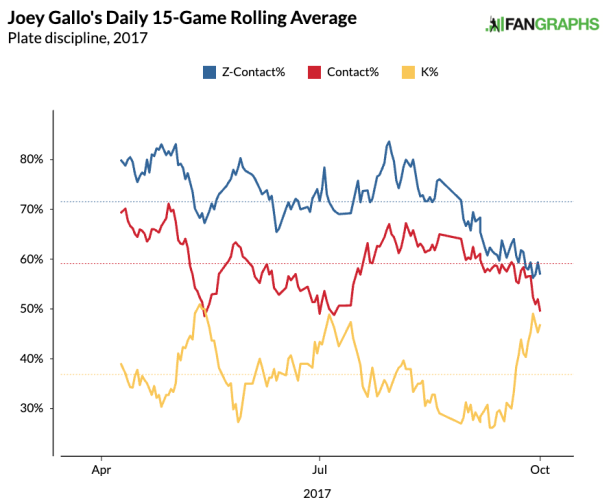
Murakami's fantasy managers need to ask themselves whether their treasured asset is the next Joey Gallo and can become just the ninth player to hit 30 home runs despite major contact issues, or will he taper off like the other outlier hitters whose contact problems failed the stress tests and the patience of major-league managers. Murakami at least has the luxury of playing for a non-contender, so the White Sox will not be in any rush to pull him from the lineup. You, as fantasy managers, need to ask yourself what is more likely as Murakami gets increased exposure to the league: will these contact rates worsen or get better? They are already near the breaking point according to the studies which warn us about such players, but it is tough to focus on that when these home runs are so much fun to watch.